Analyzing Server Latency Variations and Their Correlation with Decision-Making Accuracy in Cross-Continental Poker Tournaments
Greta Peters · Aug 5, 2026

Analyzing Server Latency Variations and Their Correlation with Decision-Making Accuracy in Cross-Continental Poker Tournaments
Cross-continental poker tournaments rely on distributed server infrastructure that connects players from multiple time zones and regions, and latency variations emerge as data packets travel between these nodes. Observers note that these delays range from 50 to 300 milliseconds depending on routing paths, with higher figures appearing during peak evening hours in August 2026 when multiple international events overlapped. Researchers tracking these patterns have documented how even modest increases in round-trip time influence the window available for players to evaluate hands and place bets before timers expire.
Measuring Latency Across Distributed Networks
Technicians deploy monitoring tools at each regional hub to capture real-time metrics that include packet loss rates, jitter levels, and geographic distance between client devices and central game servers. Data collected during major events shows that transatlantic routes often experience greater fluctuations than intra-European links because of submarine cable congestion and variable peering agreements between providers. Studies from academic groups indicate that synchronization protocols attempt to compensate by adjusting action timers dynamically, yet residual delays still reach players unevenly when one participant sits in Asia while another connects from South America.
Decision Windows and Accuracy Patterns
Decision-making accuracy drops when available thinking time shrinks below certain thresholds, and tournament logs reveal that fold rates on marginal hands rise sharply once latency exceeds 150 milliseconds. Analysts examining session data from 2025 through mid-2026 found that players facing consistent sub-100 millisecond connections posted higher expected value on river decisions compared with those experiencing spikes above 200 milliseconds. The difference appears most pronounced in multi-table formats where simultaneous action across tables compounds the effect of any single delayed response.
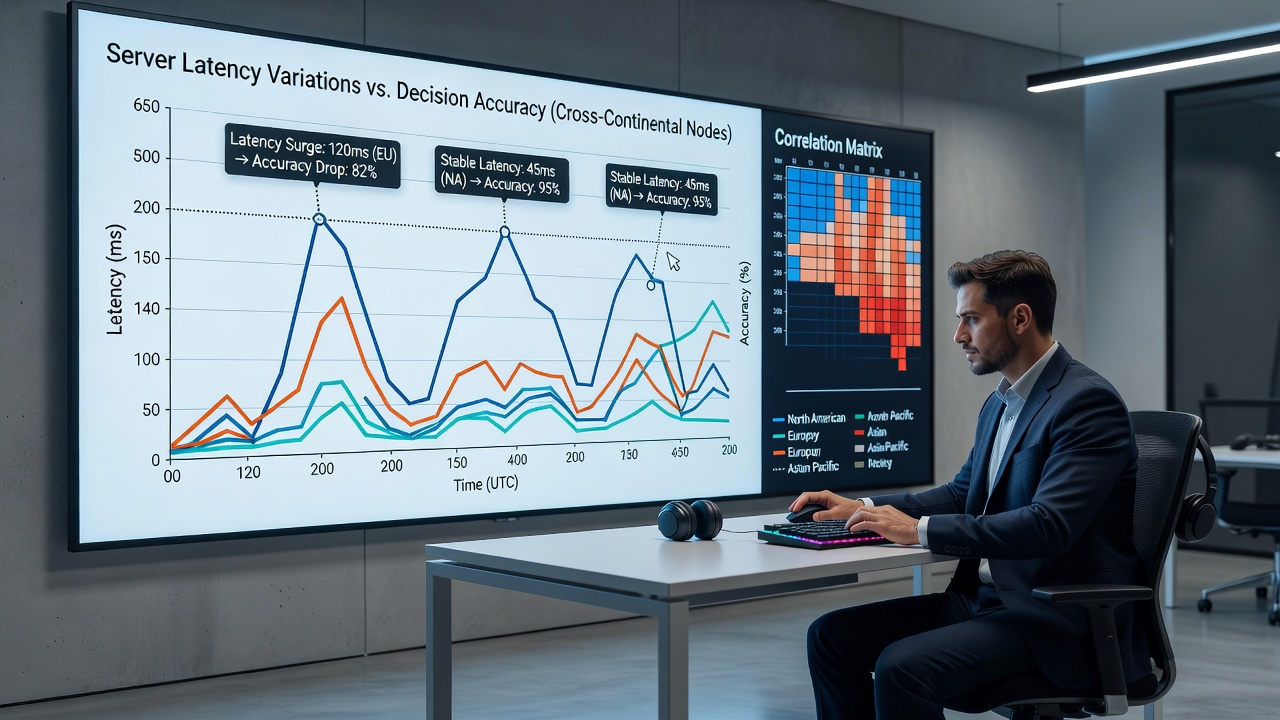
One case study tracked participants in a series of August 2026 qualifiers and noted that individuals routed through optimized CDN edges maintained steadier accuracy curves, while those on standard ISP paths showed increased error rates on timing-sensitive bluffs. Equipment differences also factor in, because mobile connections introduce additional variability compared with wired broadband setups even when the underlying server farm remains the same.
Regional Infrastructure Influences
Network conditions vary by continent, and reports compiled by the Australian Communications and Media Authority highlight that Oceania-based players encounter distinct latency signatures when matched against North American opponents because of longer oceanic cable hops. In parallel, European regulatory filings document how local data centers reduce average ping times for intra-EU matches but leave intercontinental sessions exposed to the same global routing challenges. These geographic realities create uneven playing fields that tournament operators attempt to mitigate through regional matchmaking algorithms and staggered start times.
Statistical models built from aggregated tournament telemetry suggest a linear relationship between average latency and deviation from optimal strategy, with each additional 50 milliseconds correlating to measurable drops in win-rate consistency across large sample sizes. Observers tracking these trends emphasize that raw speed alone does not determine outcomes, since player skill and bankroll management still dominate long-term results even when latency fluctuates.
Compensation Techniques and Their Limits
Some platforms introduce client-side prediction layers that anticipate player inputs and smooth over brief delays, yet these systems occasionally produce desynchronization artifacts when actual server confirmation arrives late. Research papers from institutions such as those affiliated with the Innovation, Science and Economic Development Canada examine how predictive buffering interacts with regulatory requirements for fair play, and findings indicate that transparent disclosure of latency compensation remains essential for maintaining trust across borders. Tournament directors have begun publishing latency statistics alongside final results in select events, allowing participants to review whether network conditions influenced any particular session.
Future Monitoring Approaches
Emerging telemetry standards aim to standardize latency reporting across operators so that cross-continental comparisons become more reliable. Engineers continue refining edge server placement while testing new routing protocols that prioritize low-jitter paths for real-time gaming traffic. Data gathered in August 2026 already serves as a baseline for these improvements, and ongoing collection efforts will determine whether accuracy gaps narrow as infrastructure evolves.
Conclusion
Server latency variations in cross-continental poker tournaments correlate with shifts in decision-making accuracy according to multiple measurement campaigns and session analyses. Regional infrastructure differences, routing distances, and compensation mechanisms each contribute to the observed patterns, and continued monitoring will clarify how these technical factors interact with player performance over time.