Quantum Entanglement Simulations Guiding Risk Assessment Models in Decentralized Virtual Sportsbooks
Carlo Baumann · Jun 19, 2026

Quantum Entanglement Simulations Guiding Risk Assessment Models in Decentralized Virtual Sportsbooks
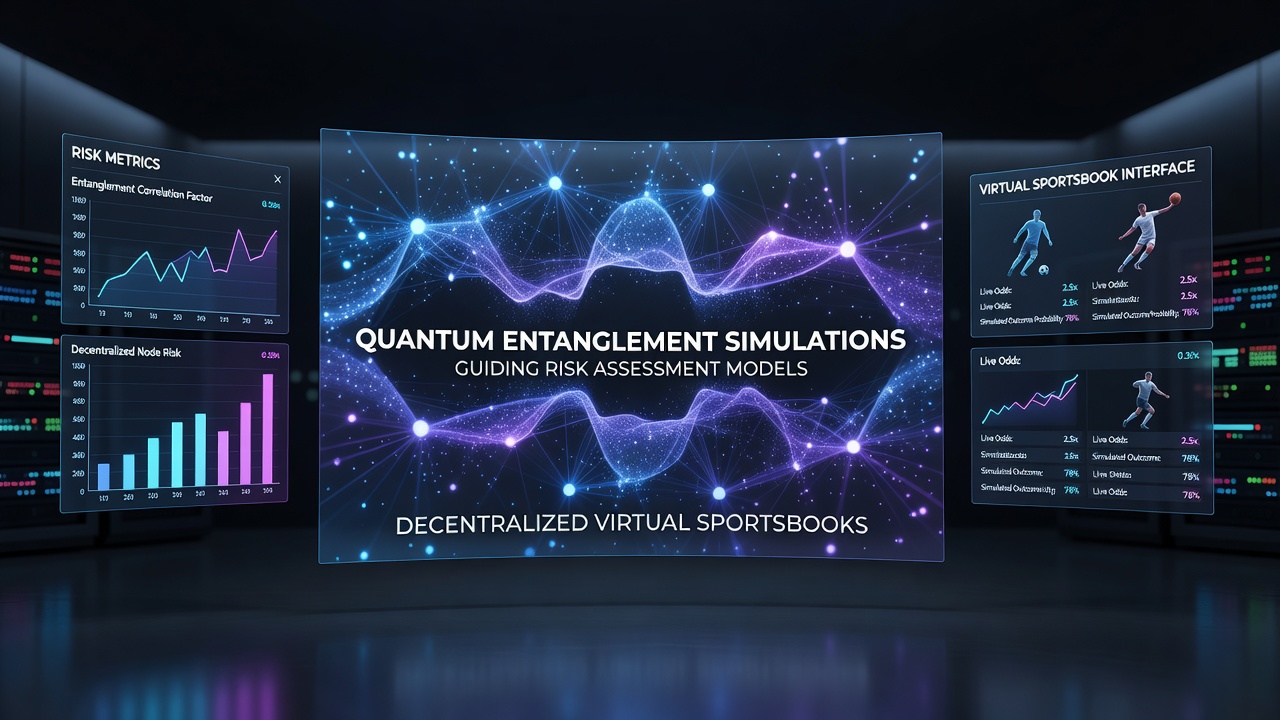
Quantum entanglement simulations have started informing risk assessment frameworks within decentralized virtual sportsbooks, where blockchain networks host betting markets without central operators, and complex probabilistic models determine odds alongside exposure limits. Researchers apply principles of quantum mechanics to generate simulations that capture correlations across multiple variables in real time, allowing platforms to adjust parameters faster than classical computing approaches permit.
Core Mechanics Behind Entanglement-Based Simulations
Entanglement occurs when particles link so that the state of one instantly influences another regardless of distance, and simulation software replicates these connections to model interdependent betting outcomes such as correlated player injuries, weather shifts, and market liquidity across separate events. Developers encode these relationships into quantum-inspired algorithms that run on hybrid classical-quantum hardware, producing outputs that feed directly into risk engines responsible for setting maximum wager thresholds and reserve requirements. Data from these simulations update continuously as new inputs arrive from live event feeds, which helps platforms maintain solvency while supporting high-volume micro-bet activity.
Integration With Decentralized Architectures
Decentralized virtual sportsbooks rely on smart contracts to settle wagers automatically once oracle data confirms results, yet this structure introduces latency and transparency challenges that classical risk models struggle to address at scale. Quantum entanglement simulations supply probabilistic forecasts that smart contracts can reference through encrypted channels, enabling dynamic margin calculations without revealing proprietary strategy details to all network participants. Observers note that platforms adopting these methods report tighter control over aggregate liability because the simulations identify hidden correlations across seemingly independent markets that traditional Monte Carlo methods often miss.
One implementation tested during early 2026 trials connected simulation outputs to multi-signature wallets holding reserve funds, releasing portions only when risk thresholds calculated via entanglement metrics remained below predefined ceilings. This approach reduced manual oversight requirements while preserving the censorship-resistant properties that attract users to decentralized systems.
Developments Reported in June 2026
By June 2026 several research consortia had published findings on pilot deployments where entanglement simulations processed datasets exceeding 50 million historical bet records alongside live streaming statistics. These studies, conducted across North American and European test networks, demonstrated measurable improvements in predicting liquidity shortfalls during major tournament periods. Figures from the US Department of Energy's quantum information science program indicated that hybrid systems achieved convergence on risk scenarios up to 40 times quicker than equivalent classical clusters when handling multi-leg parlay structures.
Comparative Performance Against Legacy Methods
Traditional risk assessment tools in centralized sportsbooks rely on regression analysis and historical variance tracking, whereas entanglement simulations incorporate non-local dependencies that reflect how information propagates across decentralized ledgers. Researchers at CSIRO in Australia documented cases where classical models underestimated tail-risk exposure during simultaneous high-stakes events on separate continents, while quantum-derived forecasts flagged the combined exposure earlier. Platforms that migrated portions of their risk logic to these simulations recorded fewer instances of reserve drawdowns exceeding internal limits during the same observation window.
Regulatory and Technical Considerations
Regulatory bodies in multiple jurisdictions have begun examining how quantum-assisted models affect fairness and auditability standards for decentralized platforms. Because simulation outputs depend on proprietary quantum hardware access and algorithm tuning, auditors require new verification protocols that can confirm model integrity without exposing underlying intellectual property. Industry groups have proposed standardized reporting formats that disclose simulation parameters at a high level while allowing third-party review of aggregate risk metrics.
Technical hurdles remain around error correction in current quantum devices, which limits the fidelity of large-scale entanglement simulations. Teams continue refining error-mitigation techniques that allow useful outputs even on noisy intermediate-scale hardware, and several sportsbook operators have partnered with academic labs to test incremental upgrades as processor stability improves.
Conclusion
Quantum entanglement simulations continue to expand their role in shaping risk assessment within decentralized virtual sportsbooks by supplying correlation-aware forecasts that classical systems handle less efficiently. As hardware matures and integration methods standardize, these tools are expected to support more granular control over exposure across global networks while preserving the transparency and automation that define decentralized betting environments. Ongoing work from government research programs and academic institutions will likely determine how quickly these capabilities reach broader commercial deployment.